


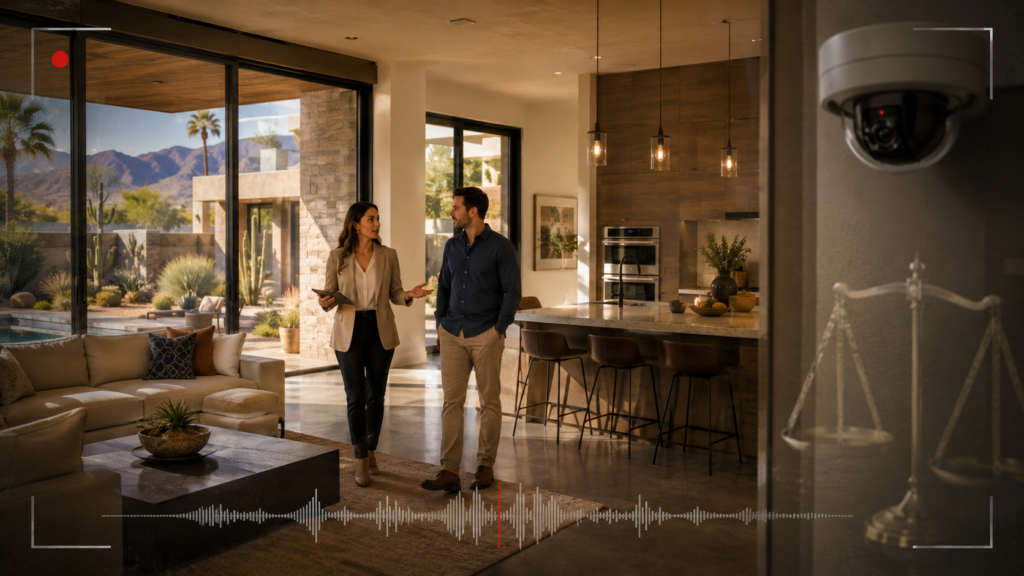
Nearly three-quarters of recent homebuyers say they’ve seen or suspected a camera, microphone, or recording device while touring a home, according to a new survey by LendingTree covered by the New York Post. More than half of sellers admit they had recording devices active during a walkthrough — and nearly one in five say they used the footage specifically to find out what buyers really thought.
In Arizona, that dynamic is amplified. An estimated 300,000 to 400,000 snowbirds pour into the Phoenix metro alone each winter, and many leave second homes and luxury properties sitting empty for months at a stretch — exactly the kind of vacant, high-value listing where owners lean hardest on smart security. Nationally, 30% of internet-connected households now own a smart camera or video doorbell, averaging better than two devices per household, according to Parks Associates. Arizona agents interviewed for the LendingTree story say the technology has become close to standard equipment in the Valley’s higher-end and seasonally vacant listings — devices like Ring, Nest, and Blink, or built-in smart hubs on kitchen countertops, are often left running with audio enabled long after installation.
That’s where the risk starts. A security camera protecting a house is legal. A security camera used to secretly listen in on a buyer’s private conversation during a showing can cross into criminal wiretapping under Arizona law. Here’s what the statutes actually say, what’s already happened in real Arizona transactions, and what buyers and agents should each do about it.
The Numbers Behind the Trend
From the LendingTree survey of recent buyers and sellers:
- 72% of buyers say they’ve seen or suspected a recording device during a showing.
- 56% of sellers admit a recording device was active during a walkthrough.
- Of those sellers, 61% say it’s for protection, 19% admit they listened in to gauge what buyers liked or disliked, 18% wanted to gauge buyer interest, and 6% wanted to hear what the real estate agent said about the home.
- 22% of buyers now avoid discussing offer strategy or budget inside a home, communicating with their agent only by text while on the tour.
- 22% avoid showing excitement about a home and 21% avoid saying anything negative — in both cases, specifically so it can’t be used against them in negotiations.
- 19% of buyers say they’ve left a showing or open house because they felt they were being watched.
Is It Legal in Arizona?
Arizona is a one-party consent state under A.R.S. § 13-3005: recording a conversation is lawful only if at least one participant in that conversation consents. A homeowner recording video in the common areas of their own house is generally not a problem — but a smart camera or hub that captures audio of a buyer and their agent talking privately, with no one in the room aware of or consenting to the recording, is a different matter. Neither the buyer nor the agent has consented, and the seller isn’t a participant in that conversation. That’s a Class 5 felony under Arizona’s wiretapping statute.
“Video recording inside the private home is a common practice. Audio is a dangerous legal minefield.” — Greg Field, Solar Home Realtor®, HomeSmart Realty Pros, Tempe, AZ
“If the buyer or showing agent does not know that the microphone is recording everything they say, there is no consent from any party in that room. That is not only a violation of the real estate ethics code, but it also becomes a possible wiretapping case.” — Greg Field
Video without audio carries less legal risk in common living spaces, since buyers touring a home have a limited expectation of privacy there. But A.R.S. § 13-3019 makes it a felony to secretly photograph, film, or record someone in a bathroom, bedroom, or similar space where they have a reasonable expectation of privacy — a real concern for cameras left active in primary suites and bathrooms during showings.
There’s civil exposure too. Under A.R.S. § 12-731, anyone whose conversation was illegally intercepted can sue for actual damages, statutory damages of $100 per day of violation, attorney’s fees, and potentially punitive damages, within one year of discovering the violation.
Arizona MLS listings include a required field for disclosing audio/video surveillance on the property — but enforcement is inconsistent.
“Some agents also put in the private agent remarks regarding if that is in use as a heads up, but audio should really be disabled to be compliant with the law. However, this isn’t really being enforced based on what I’ve seen yet and it’s hard to police.” — Cara Ameer, Coldwell Banker (licensed in CA and FL)
It’s Already Playing Out in Arizona Deals
This isn’t theoretical. Field described a Tempe listing with an active smart hub on the kitchen countertop:
“The buyers came, insulted the interior paint job, said nasty things about the seller, and openly boasted how low their offer will be. And they said this in front of the person who was watching it on their cell phone live. The owner took it personally and two days later, when those buyers made an offer, she rejected it immediately. Egos destroy deals way faster than leaky roofs.” — Greg Field
Cameras cut both ways. In a Scottsdale showing, a foyer camera settled a dispute after a child knocked over a custom lighting fixture and the showing agent claimed the glass was already broken — the footage showed otherwise, and the brokerage’s insurance paid the claim without argument.
The most damaging overheard comments tend to be financial, not emotional.
“The comments a potential buyer makes about the cash they have available to buy the potential property, how flexible their timeline is, what their contingencies are and how costly or how far their pre-approval stretches, affect or severely limit the potential buyer’s negotiating position. A seller who overhears that a potential buyer has the financial means to buy the property and is also willing to buy the property has the incentive to hold firm or counter the price.” — Cody Schuiteboer, President & CEO, Best Interest Financial
What Arizona Buyers Should Do
- Assume every showing is being recorded — audio and video — starting from the moment you pull into the driveway. Modern smart doorbells can pick up clear audio from roughly 50 feet away.
- Save budget, financing details, timeline flexibility, contingencies, and offer strategy for the car or a phone call after you’ve left the property, not for inside the house.
- Keep your reactions neutral in the moment. Save both enthusiasm and criticism for later so they can’t be used against you in negotiations.
- Ask your agent whether the listing’s MLS surveillance field or private remarks disclose active recording devices before you tour.
- If you come across a hidden camera or microphone in a bedroom or bathroom, or you’re just not sure whether a conversation was recorded, it’s worth taking a photo or note of what you saw and letting your agent know. Depending on the circumstances, there are a few paths forward — from a simple conversation with the listing agent to, in more serious cases, a civil claim under A.R.S. § 12-731 or a criminal complaint.
What Arizona Agents Should Do
- At listing intake, inventory every smart device on the property with the seller in writing, and disable interior microphones and any bedroom or bathroom cameras for the duration of the listing period.
- Complete the MLS audio/video surveillance disclosure field on every listing — don’t rely on private remarks alone, and don’t assume buyers’ agents will ask.
- Get sellers to sign a written acknowledgment that they will not actively monitor or record showings without consent. Some brokerages already require this, and it’s a reasonable standard for any listing agreement.
- Brief buyer clients before every showing: hold financial and strategy conversations outside the property, and communicate anything sensitive by text or phone once you’re inside.
- If you learn a seller is using recordings to gain negotiating leverage, involve your broker immediately. Beyond the wiretapping exposure, it raises real Code of Ethics concerns and can taint the transaction for everyone involved.
The Bottom Line
Smart cameras aren’t going away, and in a market like Arizona’s — full of vacant snowbird homes and camera-equipped luxury listings — they’re only getting more sophisticated. The technology itself isn’t illegal. What sellers, and the agents representing them, do with the audio is where the real risk lives.
“Treat every home visit as a formal business negotiation held in a public place. Control your emotions until you leave the neighborhood.” — Greg Field
This article is for general information only and is not legal advice. If you have questions about a specific listing, recording, or transaction, consult a licensed Arizona real estate attorney.
Sources: LendingTree buyer/seller survey as reported by the New York Post (“Sellers are using smart cameras to eavesdrop on homebuyers — but listening in comes with risks,” Aug. 1, 2026); Parks Associates smart home device research; Arizona Revised Statutes §§ 13-3005, 13-3019, 12-731.